In the previous post, we talked about reverse the entire LinkedList. You also can get info about what is it LinkedList and a high-level view of how it works.
Today we will talk about a case when we need to revert linked list nodes in groups of a given size.
Algorithm theory
Task definition
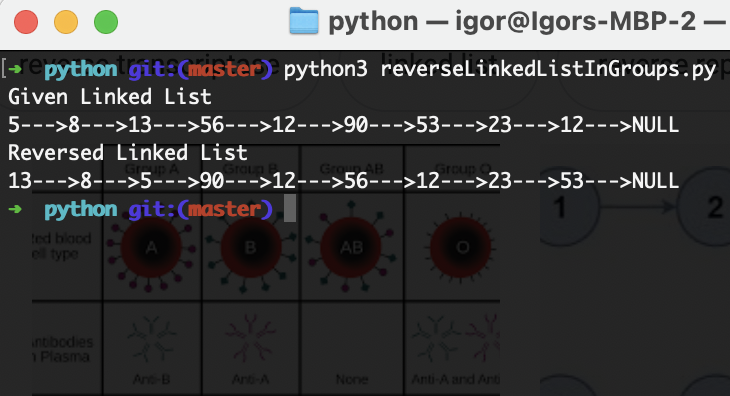
Given LinkedList: 5–>8–>13–>56–>12–>90–>53–>23–12–>NULL Given group size: 3 We need split linked list into groups and reverse the nodes. The result linked list must be like this: 13–>8–>5–>90–>12–>56–>12–>23–53–>NULL
Solution
Reverse the first sub-list of size k. While reversing keep track of the next node and previous node. Let the pointer to the next node be next and the pointer to the previous node be prev. See this post for reversing a linked list.
head->next = reverse(next, k) ( Recursively call for rest of the list and link the two sub-lists )
Return prev. Prev becomes the new head of the list
Sample code
Below you will get a link to GitHub repo with Kotlin, Java, and Python source code
Linked list is a data structure each element of those has link to the next element.
Each element of the linked list called node
The node of linked list called head. To identify the whole linked list we need link to head only.
The linked lists are great in insertion and deleting first and last elements. They can used for implementing stacks, queues.
Time and complexity for LinkedList
Operation
Complexity explanation
Complexity formula
Insertion
constant
O(1)
Deletion
constant
O(1)
Search
linear
O(n)
Space
linear
O(n)
Algorithm theory
Task definition
We have a linked list.
We need reverse items in the existing linked list.
Solution
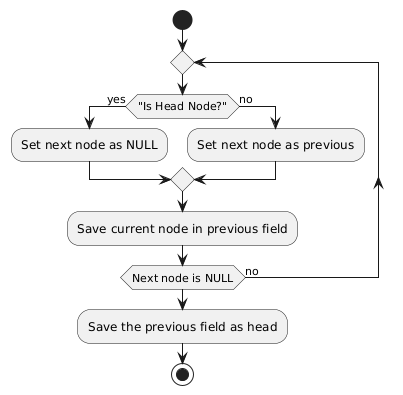
The simplest way to solve the task is to iterate through the list and set the previous node as the next node for each node. The next node for the first node must be null.
The complexity in this case will be 0(n).
Diagram
Sample code
Below you will get a link to GitHub repo with Kotlin, Java, and Python source code
Algorithm for finding the shortest path from one vertex of the graph to all the others.
This algorithm was developed by the Dutch scientist Edsger Wybe Dijkstra in 1959.
The algorithm works only for a directed graph in which the edges have no negative weight and do not have loops. Or is works only with DAG (Directed Acyclic Graph).
Task:
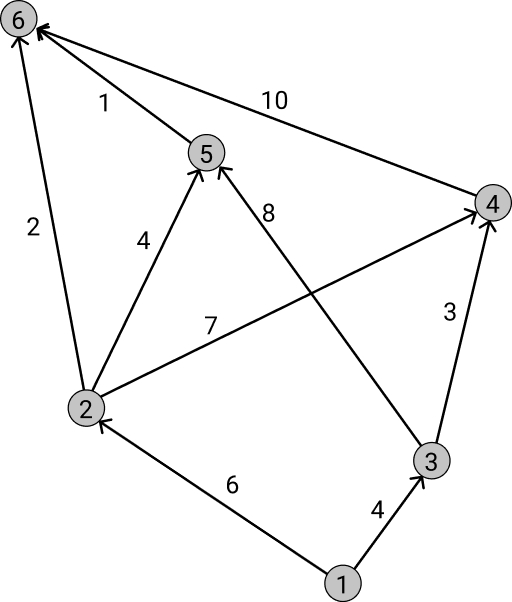
Given a weighted directed graph without negative weight arcs. Find the shortest paths from vertex “1” to all others
Solution
We make a table of distances from the vertex “1” to all the others, including the vertex “1”.
Iteration 0.
Mark vertex 1 as a base vertex. We know that the distance from vertex 1 to vertex 1 is 0. It is less than infinity. We write it down to the table. For the rest of the vertices, for now, write down the distance value equal to infinity. Select the smallest distance value from the first iteration. This is distance 1-1. Vertex 1 is resolved. Moving on to the next iteration
# Iter
Vertex 1 (resolved)
Vertex 2
Vertex 3
Vertex 4
Vertex 5
Vertex 6
0
0
∞
∞
∞
∞
∞
Iteration 1.
From vertex 1 you can go to vertex 2 and 3. The distance from vertex 1 to vertex 2 will be 0 + 6 = 6 (edge weight 1-2). 6 is less than infinity. We write to the table. The distance from vertex 1 to vertex 3 will be 0 + 4 = 4 (edge weight 1-3). 4 is less than infinity. We write to the table. Select the smallest distance value from the first iteration. This distance is from 1-3. Vertex 3 is resolved. It is now basic. Moving on to the next iteration
# Iter
Vertex 1 (resolved)
Vertex 2
Vertex 3 (resolved)
Vertex 4
Vertex 5
Vertex 6
0
0
∞
∞
∞
∞
∞
1
6
4
∞
∞
∞
Iteration 2.
From vertex 3 you can go to vertex 4 and 5. The distance from vertex 3 to vertex 4 will be 4 + 3 = 7. 7 is less than infinity. We write to the table. The distance from vertex 3 to vertex 5 will be 4 + 8 = 12. 12 less than infinity. We write to the table. Transfer the distance value 1-2 to the second iteration without changes. Select the smallest distance value from the second iteration. This distance is from 1-2. Vertex 2 is resolved. Vertex 2 is now basic. Moving on to the next iteration
# Iter
Vertex 1 (res-d)
Vertex 2 (res-d)
Vertex 3 (res-d)
Vertex 4
Vertex 5
Vertex 6
0
0
∞
∞
∞
∞
∞
1
6
4
∞
∞
∞
2
6
7
12
∞
Iteration 3.
From vertex 2 you can go to vertex 4, 5, and 6. The distance from vertex 2 to vertex 4 will be 6 + 7 = 13. 13 is greater than 7, which is already in the table. We transfer the value from the previous iteration to the current one. The distance from vertex 2 to vertex 5 will be 6 + 4 = 10. 10 is less than 12. Write it down in the table. The distance from vertex 2 to vertex 6 will be 6 + 2 = 8. 8 is less than infinity. We write to the table. Select the smallest distance value from the third iteration. This distance is from 1-4. Vertex 4 is resolved. Vertex 4 is now basic. Moving on to the next iteration
# Iter
Vertex 1 (res-d)
Vertex 2 (res-d)
Vertex 3 (res-d)
Vertex 4 (res-d)
Vertex 5
Vertex 6
0
0
∞
∞
∞
∞
∞
1
6
4
∞
∞
∞
2
6
7
12
∞
3
7
10
8
Iteration 4.
From vertex 4, you can only get to vertex 6. The distance from vertex 4 to vertex 6 will be 7 + 10 = 17.17 is greater than 8, which is already in the table. We transfer the value from the previous iteration to the current one. The distance value 1-5 is transferred to the second iteration without changes. Choose the smallest distance value from the fourth iteration. This distance is from 1-6. Vertex 6 is resolved. Vertex 6 is now basic. Moving on to the next iteration
# Iter
Vertex 1 (res-d)
Vertex 2 (res-d)
Vertex 3 (res-d)
Vertex 4 (res-d)
Vertex 5
Vertex 6 (res-d)
0
0
∞
∞
∞
∞
∞
1
6
4
∞
∞
∞
2
6
7
12
∞
3
7
10
8
4
10
8
Iteration 5.
From vertex 5, you can only go to vertex 6. The distance from vertex 5 to vertex 6 will be 10 + 1 = 11. 11 is greater than 8, which is already in the table. We transfer the value from the previous iteration to the current one. Vertex 5 has been resolved.
All vertices are resolved. The algorithm is complete. The shortest distances from vertex 1 to all other vertices can be seen in the table.
# Iter
Vertex 1
Vertex 2
Vertex 3
Vertex 4
Vertex 5
Vertex 6
0
0
∞
∞
∞
∞
∞
1
6
4
∞
∞
∞
2
6
7
12
∞
3
7
10
8
4
10
8
5
8
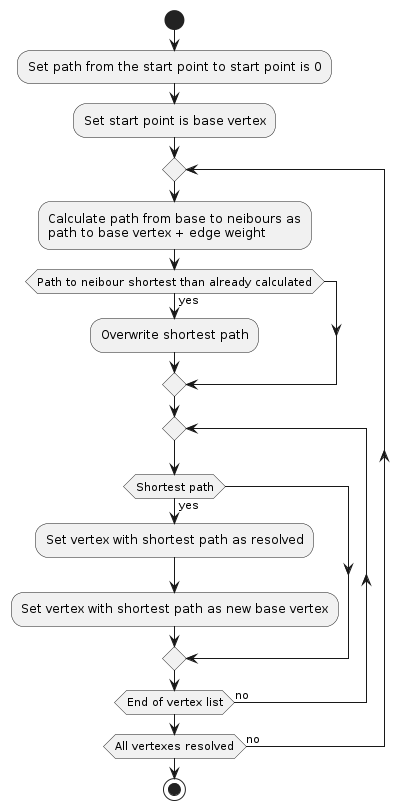
PlantUML diagram of the algorithm
Sample code
Below you will get link to github repo with Kotlin, Java, and Python code




 Sample code
 Sample code